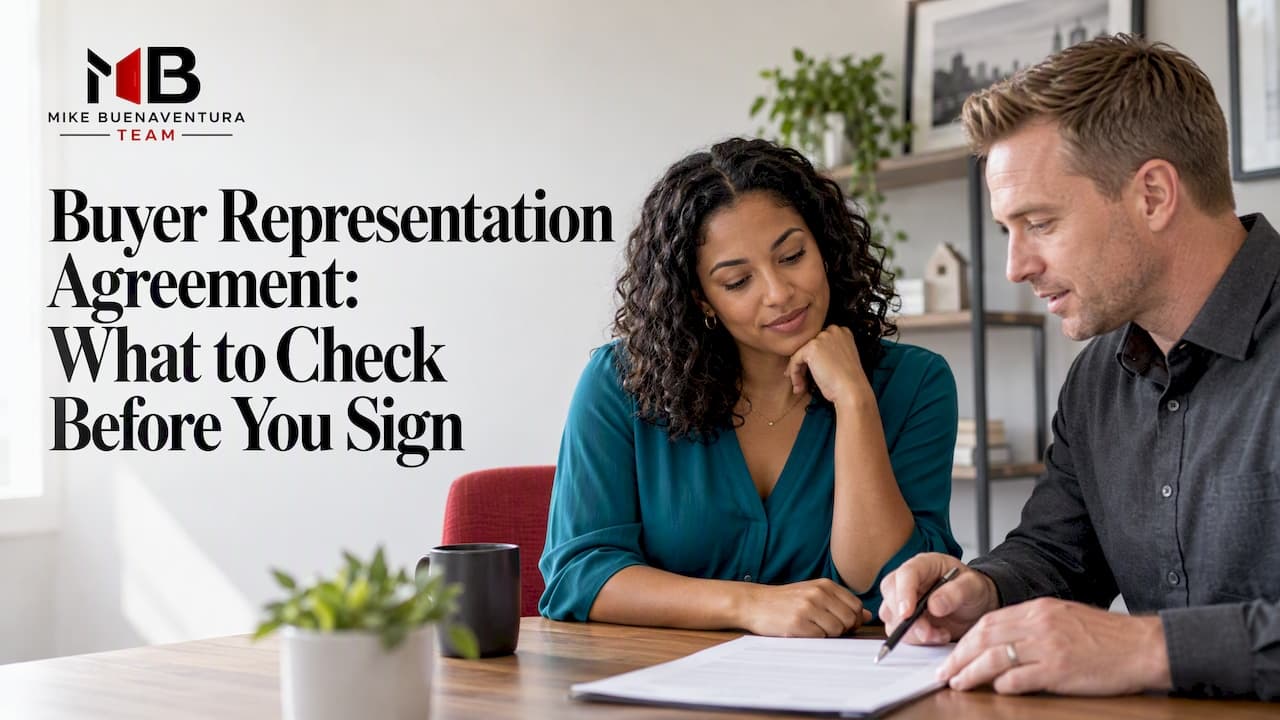
A buyer representation agreement is a written contract between you and a real estate brokerage. It sets out the services you will receive, how long the relationship lasts, how the brokerage gets paid and how either side can end it. Across Canada, Ontario's regulator describes it as the document that spells out duties, services, rights and responsibilities, payment, duration and cancellation. Signing one is increasingly the first step before an agent shows you homes, so it pays to read it like any other contract.
This guide explains what the agreement does, what "exclusive" means for you, which clauses deserve a second look and how to ask for changes before you sign. Rules differ from province to province, so we name the province behind each rule. If you are buying in Winnipeg, we are happy to walk you through the paperwork before you commit to anything.
TL;DR
- A buyer representation agreement makes you a client of a brokerage and spells out services, fees, term and exit terms in writing.
- Many agreements are exclusive: for the stated time and area, you work with that brokerage only.
- Check the expiry date, the area covered, how and when commission is paid, the termination terms and any holdover clause.
- Compensation is negotiated between you and the brokerage. In Ontario, no regulator or board sets it, and the same principle of negotiation applies when you talk to any agent.
- Ask questions and request changes before you sign, not after you have found a home.
Table of Contents
- What a buyer representation agreement is
- What your agent does under the agreement
- What "exclusive" means for you
- The clauses to read line by line
- What if the agent represents both sides?
- When you are asked to sign
- A short checklist before you sign
- Our perspective
- Working with us in Winnipeg
- Frequently asked questions
- Sources
What a buyer representation agreement is
Think of it as the job description for your agent, written down. Before these agreements became common, many buyers worked with an agent on a handshake. The agreement replaces that with a document both sides can point to.
In British Columbia, the BCFSA calls its version a legally binding contract between the buyer and the brokerage the professional is licensed with. Nova Scotia's regulator publishes separate forms for a standard buyer brokerage agreement and a buyer designated brokerage agreement, and both include the parties' obligations, remuneration, use of information, and start and expiry dates.
The names vary: buyer representation agreement, buyer's agency agreement, buyer brokerage agreement. The idea is the same. You are hiring a brokerage to represent you in buying a home.
Why it matters: client versus customer
Signing turns you from a person an agent is helping into a client of the brokerage. In BC, the BCFSA says the professional has a legal duty to act in the buyer's best interest once you are their client. Without an agreement, the relationship is thinner, and in Ontario a buyer should not expect services such as home showings unless one is signed.
What your agent does under the agreement
The agreement must describe the services you receive. In Ontario, RECO notes that there is no standard service package, because brokerages offer different service options. That makes the services clause worth reading closely.
Nova Scotia's consumer guide gives a useful picture of what a buyer's representative typically does: searches listings, arranges appointments and showings, conducts research, explains and helps prepare forms, and provides or sources information about properties, communities, taxes, utilities and zoning.
In practice, a good agreement for a Winnipeg purchase should leave you clear on:
- how you will be sent new listings, and how fast
- whether the agent can arrange viewings of off-market or pre-market properties
- who prepares and explains the offer, and how conditions are handled
- what help you get with negotiation, inspections and closing
- how you and your agent will communicate during the search
Our own Home Finder is one example of how a search service can be set up. Whatever you choose, you should be able to point to the line in the agreement that promises it.
What "exclusive" means for you
Most buyer agreements you will see are exclusive. That means that for the period and area written in the contract, you agree to work with that brokerage only. In BC, signing commits the buyer to work exclusively with that brokerage for the specified time and region.
What that looks like in daily life:
- You cannot sign a second agreement with another brokerage for the same search while the first is in force.
- If you buy a home in the covered area during the term, the brokerage you signed with is generally the one paid, even if you found the house some other way. Check the wording.
- If you want to search outside the stated area, the clause for scope matters. A narrow area gives you freedom elsewhere. A broad one does not.
Exclusivity is not a trap. It is what allows an agent to invest real time in your search, knowing the work will not be lost to someone else. The key is that the term and the area are ones you are comfortable with.
The clauses to read line by line
RECO's guidance says an agreement should state its scope, services, compensation or how it is calculated, expiry date, the circumstances for termination and any holdover clause. BCFSA lists a similar set. Here is how to read each one.
| Clause | What to look for | A question to ask |
|---|---|---|
| Type of representation | Whether the agent represents only you | "Will you ever represent the seller too?" |
| Services | Specific duties, not general promises | "Where is the off-market access written down?" |
| Area or property scope | The cities, neighbourhoods or property types covered | "Can we narrow this to Winnipeg and named areas?" |
| Compensation | Fixed fee, percentage or a combination, and when it is due | "What do I owe if the seller's side pays less?" |
| Start and expiry date | A clear date, prominently shown | "Can we start with a shorter term?" |
| Termination | How either side can end it early, and any penalty | "What happens if we are not a fit?" |
| Holdover | How long after expiry you may still owe commission | "How long does the holdover last and for which homes?" |
Compensation: who pays and how much
Compensation is a negotiation. RECO states that in Ontario it is negotiated between buyer and brokerage and is not fixed or approved by RECO, government or a real estate association or board. Fees may be a fixed amount, a percentage or a mix of both.
The point most buyers miss is what happens when the seller's listing brokerage offers less than the amount in your agreement. BCFSA says the agreement should state the commission payable if the listing brokerage does not provide the amount charged, and when commission is payable. In Ontario, RECO says buyer agreements must explain changes if the seller pays. Ask for a worked example with real numbers before you sign.
Budget for this early. Our guide on hidden closing costs when buying in Winnipeg shows the other costs that show up at the end of a purchase, so nothing surprises you on possession day.

Term and expiry
There is no single required length. RECO notes Ontario has no standard term, but the expiry date must be prominent. BCFSA says the agreement should specify its effective date and expiry date. If you are new to buying or unsure of the fit, ask for a shorter initial term and an option to renew once you have seen how the work goes.
Ending the agreement early
BCFSA says the agreement should cover what happens if either side wants to end it early. Read this clause before you need it. Ask whether termination is by mutual consent, whether there is a fee and what happens to a home you were already shown.
If you later want to move to a different brokerage, the process can be formal. Nova Scotia's Commission says a transfer needs consent from the client, the transferring broker and the receiving broker. If the agency models differ, the original agreement is terminated and a new one signed.
Holdover clauses
A holdover clause says that if you buy a home within a set period after the agreement ends, and the brokerage introduced you to it, commission may still be owed. It is a common feature of the contract, and it is fair when the period is short and the wording is specific. Ask for it to cover only properties the agent actually showed you or introduced you to in writing.
What if the agent represents both sides?
Sometimes the same brokerage lists a home you want. This is where the agreement does real work. In Ontario, the buyer does not have to agree to multiple representation, and the agreement should say what happens in that case, for example ending the agreement or referring you to another brokerage or a designated representative.
Read that clause now, not when you are standing in front of the house. If you are not comfortable with the arrangement, say so, and make sure the contract reflects it.
When you are asked to sign
Timing rules differ by province. In Ontario, RECO says representation agreements must be in writing and presented as soon as possible. In Nova Scotia, the Commission says a buyer designated brokerage agreement must be signed as soon as an agency relationship occurs, after the working-with-industry disclosure and before an offer is prepared or advice is given. You must receive a copy immediately after signing.
For a Winnipeg purchase, confirm Manitoba's current requirements with your agent and the provincial regulator. A good agent will explain them plainly.
A short checklist before you sign
- Read the whole document at home. You do not need to decide in the showroom or the car.
- Confirm what is exclusive. Which area, which property types and for how long.
- Get the fee in numbers. Ask for a written example, including what you owe if the seller's side pays less than expected.
- Check the dates. Start, expiry and any holdover period.
- Understand the exit. How either side ends the agreement, and at what cost.
- Ask about dual representation. What the contract says if your agent also represents the seller.
- Ask for a copy. Keep it with your mortgage and purchase documents.
While you are getting organized, a mortgage prequalification tells you your price range, and the home buying timeline shows where the agreement fits among the other steps.
Our perspective
We think the agreement should be the least mysterious part of buying a home. When we sit down with a buyer in Winnipeg, we want you to know what we do, what you are agreeing to and how we communicate, before anything is signed.
Our approach is built on transparent communication and service tailored to your goals, from the first consultation through to closing. For us, a representation agreement is the written version of that promise. It is where a personalized plan becomes something you can hold us to.
That is also why we encourage questions. Ask us to walk through every clause. Ask what the search looks like week to week. Our Home Finder Program is designed to put the right listings in front of you, including exclusive off-market access, and our team's experience and volume of sales help us negotiate with confidence on your behalf.
A buyer who understands the contract is a buyer who can focus on the home.
the author
Working with us in Winnipeg
If you are planning to buy in Winnipeg or the surrounding communities, we can explain our process and the agreement before you decide anything. Our buying service covers property search, negotiation support and guidance through every stage, including the Home Finder Program.

First-time buyer? Our first-time home buyers guide pairs well with a conversation. You can also contact us to book a consultation. We will take you through the agreement clause by clause, with no pressure to sign on the day.
Frequently asked questions
Do I have to sign a buyer representation agreement?
You are not forced to sign, but without one an agent may not provide the full range of services. In Ontario, RECO says a buyer without a signed agreement should not expect services such as home showings. Ask the agent what they can and cannot do for you without one.
Can I negotiate the terms?
Yes. In Ontario, RECO says compensation is negotiated between you and the brokerage, and no regulator or board sets it. You can also ask for a shorter term, a narrower area or a clearer holdover clause. Do this before you sign.
What happens if I find a home on my own?
It depends on the wording. If the agreement is exclusive and covers the area, the brokerage may still be owed commission on a purchase in that period. Ask the agent to explain exactly how the clause applies, and request a written example.
What if the agent represents both the buyer and the seller?
In Ontario, you do not have to consent to multiple representation. The agreement should say what happens instead, such as ending the agreement or referring you to another brokerage or a designated representative. Read this clause before you start viewing homes.
Can I switch agents mid-search?
Possibly, but not unilaterally. In Nova Scotia, a transfer needs consent from you, the original broker and the new broker. Otherwise, you would terminate the original agreement and sign a new one. Check the termination clause for any fee.
Sources
- Signing a contract with a real estate brokerage (RECO)
- Understand Your Buyer's Agency Agreement (BCFSA)
- Consumers Guide To Buying A Home (Nova Scotia Real Estate Commission)
- About Real Estate Forms (Nova Scotia Real Estate Commission)
- Designated Agency FAQs (Nova Scotia Real Estate Commission)