
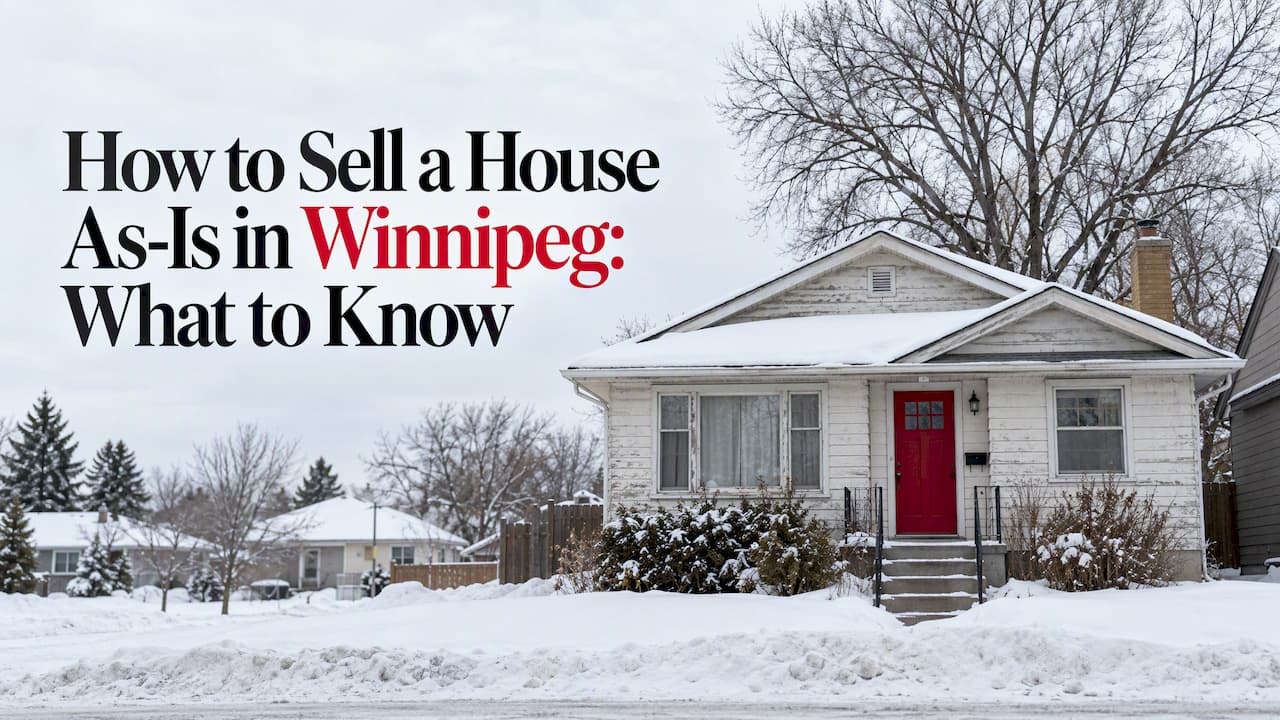
You can sell a house as-is in Winnipeg. It means you offer the home in its current condition and won't repair or credit anything to close the deal. It does not mean you can stay quiet about serious hidden problems. The sale usually goes best when you set a price that reflects the condition, market the home honestly, and have a realtor who has handled this kind of sale before.
This guide covers what an as-is sale means, what you still have to disclose, whether to fix anything first, how to price and prepare the home, and how to deal with a vacant property. It also covers the costs and the tax question that most sellers ask about.
TL;DR
- An as-is sale means no repairs and no warranties from you. It does not remove your duty to disclose known hidden defects that affect safety or habitability.
- Visible problems are the buyer's to spot. Hidden ones you know about are yours to disclose, in writing, before the offer is final.
- Price the home from recent comparable sales and adjust for condition. A realistic price matters more than any clause.
- Fix only what is cheap, safe and obvious. Deep cleaning, clearing out and photographs return more than a renovation.
- A vacant home needs insurance notice, secured keys, working utilities and regular checks while it is listed.
Table of Contents
- What "as-is" actually means
- What you still have to disclose
- Should you repair anything before selling?
- How condition affects price and who buys
- Pricing, preparing and marketing an as-is home
- Selling a vacant home
- Costs and tax to expect
- Our perspective: honesty sells houses faster
- How we help with an as-is sale
- FAQ
- Sources
What "as-is" actually means
In an as-is sale, the seller conveys the property in its present condition. A Canadian law firm's explanation of the clause in Ontario says it means no warranties or guarantees, and no obligation to repair defects before closing. The same logic applies across Canadian provinces, because it comes from common law, though the wording of contracts and forms differs. In Winnipeg, your realtor and your lawyer will draft the wording that fits Manitoba practice.
Three things people often assume are wrong:
- As-is does not mean cash buyers only. Buyers with financing can make offers too. Their lender may want an appraisal or inspection, which can complicate things if the home needs significant work.
- As-is does not mean a rock-bottom price. It means the price reflects condition. Some homes sell at or near market value because of location, lot size or a lack of competing listings.
- As-is does not mean no inspection. Buyers can still inspect. The difference is that you are not agreeing to fix whatever they find. They can accept the home, negotiate the price, or walk away if their offer allows.
What you still have to disclose
This is the part that gets sellers into trouble. Canadian law separates two kinds of defects.
A patent defect is one a buyer can see on a reasonable inspection: a cracked window, a sagging porch, worn flooring. For those, buyer beware applies. A latent defect is hidden and affects safety or habitability. Ontario's real estate regulator explains that disclosure is required for latent defects, not patent ones. Although that bulletin is from Ontario, the common-law principle is the same one Manitoba courts apply.

British Columbia's regulator describes a material latent defect as one that cannot be found through a reasonable inspection and can make the property dangerous or unfit to live in. Examples that commonly fall in this category include a history of basement flooding that has been covered up, a failed or leaking foundation hidden behind finished walls, or a known hazard in the building's systems.
The as-is clause does not erase this duty. Alberta's realtor association says the clause cannot shield a seller from a known material latent defect, because disclosure obligations can't be contracted away. The clause is better suited to situations where the seller has limited knowledge of the property, such as an estate or court-ordered sale.
Courts have taken the same view for decades. A summary of a long-standing Ontario case says a seller may be liable if they knew of a latent defect that makes a home unfit for habitation. The buyer generally has to show that the seller knew, or that the circumstances point to concealment or reckless disregard for the truth. In practice, that means what you know and what you wrote down matters.
A practical rule for disclosure
If you know something about the house that a buyer could not find out by looking, and it affects safety, habitability or serious value, tell your realtor, and put it in writing. That includes past water entry, previous insect or rodent problems you couldn't fully resolve, and any work done without a permit. Your realtor and lawyer decide how to word it. Hiding it creates far more risk than the price drop that honesty might cost you.
Also note that regulators in some provinces advise caution about mixing as-is wording with a standard property disclosure form. BC's financial services regulator suggests sellers using the clause consider avoiding a standard Property Disclosure Statement so the contract doesn't contradict itself. Ask your realtor how Manitoba practice handles this for your listing.
Should you repair anything before selling?
Usually, a little. Rarely, a lot. The decision comes down to three questions.
- Does the problem scare buyers more than it costs? A missing handrail, exposed wiring or a broken furnace make buyers imagine the worst. A small repair can remove a big discount.
- Will a buyer's lender care? Some lenders and insurers react to roof condition, active leaks, or safety issues. Those items can sink a financed offer even when the buyer loves the house.
- Can you recover the cost? A $15,000 kitchen update rarely adds $15,000 to the sale price. A $300 cleaning and a $200 handyman visit often do add visible value.
What tends to be worth doing
| Task | Typical effort | Why it helps |
|---|---|---|
| Deep clean, remove clutter | Low | Buyers read cleanliness as care. Photos improve too. |
| Patch obvious safety hazards | Low to medium | Removes fear and negotiating leverage. |
| Replace burnt-out bulbs, fix sticking doors | Low | Small things signal bigger neglect. |
| Clear the yard, garbage and old items | Low | Curb appeal drives first impressions online. |
| Pre-listing inspection | Medium | You know what a buyer will find and can disclose it properly. |
| Major renovation (kitchen, roof, foundation) | High | Often not recovered. Price the home to reflect it instead. |
If you don't want to do any work at all, that's a legitimate choice. Just price accordingly, and be ready for buyers who want to renovate. Our 30-day planner for getting ready to sell lays out what to tackle week by week when you do have time.
How condition affects price and who buys
A home that needs work attracts a different mix of buyers: renovators, investors, handy first-time buyers, and families who want to build equity. Each group runs the numbers differently. They subtract the cost of repairs, a contingency, and their own time from what a finished comparable would fetch.
So your price should work backward the same way. Look at what similar renovated homes sold for nearby, then subtract realistic repair costs. A contractor's quote for the biggest items is the most credible way to show a buyer your number makes sense. It can also stop a buyer from guessing high.
Two mistakes cost sellers the most:
- Pricing as if the house were renovated. The home sits, the listing gets stale, and the eventual sale price is lower than if you had priced right at the start.
- Pricing far below value to attract a fast offer. Without enough exposure you may leave real money behind. A competitive process often beats a single low offer.
If you are unsure what your home would fetch, a home evaluation based on local comparable sales gives you a starting range before you decide on repairs.
Pricing, preparing and marketing an as-is home
Set the price from comparables
Start with recent sales of similar homes in your neighbourhood, then adjust for condition, age of the major systems, lot and location. Your realtor should show you the comparables and explain each adjustment so you can see how the number was built. A realtor can help set a sale price, prepare the home for showings, list it online and complete the paperwork, and for an as-is property, the first of those tasks matters most.
Be open in the listing
Online buyers filter by price and photos. Describe the home plainly: say it's being sold as-is, list known issues in neutral wording, and show the good parts honestly. Surprises discovered during a showing waste everyone's time and make buyers more aggressive in negotiation. Honest marketing also keeps your disclosure record clean.

Photograph the potential
Clear the house and use daylight. Photograph the layout, the lot, the character features and the recent updates. Buyers who renovate look for good bones, so show what a clean slate could become. Our marketing strategy page explains how we promote listings across channels.
Prepare for showings and offers
- Set clear showing windows and make sure the home is safe to walk through.
- Decide in advance whether you will accept conditional offers or only unconditional ones.
- Ask your realtor how to handle inspection conditions, and what you will and won't negotiate.
- Have any permits, receipts and past inspection reports ready to share.
Once an offer is accepted, remember that an unconditional agreement means you must close regardless of issues like inspection results once conditions are removed, so talk through the terms with your lawyer first.
Selling a vacant home
Many as-is homes are empty: inherited properties, homes after a move, or houses where tenants have left. Empty houses carry their own risks and the listing needs a plan.
- Tell your insurer. Many policies have conditions for vacant properties. Check before the home sits empty. The REALTOR® checklist for vacant homes lists notifying the insurer, explaining lockboxes and extra keys, and verifying utility and security-system details.
- Keep the utilities on. Heat protects pipes through a Manitoba winter, and lights help showings. Water and power also let inspectors test systems.
- Check the property regularly. Someone should walk through after storms and cold snaps, collect mail and clear snow. A quiet house with an untouched driveway signals vacancy.
- Control the keys. Know who has copies. A lockbox is standard, but your realtor should log who enters.
- Stage lightly. Even a few pieces of furniture help buyers see the scale of the rooms. Empty rooms can look smaller in photos.
If the property belongs to an estate, our guide to selling an estate property in Manitoba covers the executor's side of the process. If the sale is tied to a separation, see selling during separation or divorce.
Costs and tax to expect
Selling is never free, even as-is. The federal consumer agency lists legal fees including a statement of adjustment and mortgage discharge fees as standard costs, with realtor fees, inspection and appraisal costs, and mortgage prepayment penalties as other possible items.
On realtor fees, the same page says commissions are negotiable and typically range from 2% to 6%, depending on the market and the services provided. Ask any realtor exactly what that fee covers, including marketing, photography and negotiation.
On the tax question: the Canada Revenue Agency explained for a 2016 sale that you had to report basic details on your return to claim the principal residence exemption. If the home was your principal residence for every year you owned it and wasn't used to earn income, you generally paid no tax on the gain. Rules can change and your situation may differ, for example if you rented part of the home or it was an inherited property, so confirm with an accountant or the CRA before you file.
Plan your net proceeds before you list. Our mortgage calculator helps if you are buying your next home with what's left.
Our perspective: honesty sells houses faster
We have seen the same pattern in as-is sales again and again. Sellers who feel embarrassed about a home's condition tend to hide it, rush the photos, and set a price that does not match the story. Buyers can sense the mismatch. Sellers who say plainly what the home is, price it from real comparable sales, and answer questions openly usually get more serious showings and fewer collapsed deals.
As a Winnipeg team, we focus on clear communication and a plan built around your goals, from the first consultation through closing. For an as-is sale, that means sitting down with you to decide which small fixes are worth doing, which problems to disclose and how, and what price will bring real offers in your neighbourhood. We do not promise a number before looking at the home. We promise to explain how we got to the one we suggest.
If you're selling because of a life change, such as an inherited house, a separation or a move, the sale is rarely just about money. We try to keep the process calm and predictable so you can focus on the rest.
— User
How we help with an as-is sale
We help Winnipeg owners list homes in any condition. That includes a local home evaluation, marketing that shows the home honestly, and negotiation support once offers arrive. You can read how the process works on our selling a home page, or see what past clients say in our reviews. If you are also looking for your next place, our Home Finder can start your search while the sale is underway.
FAQ
What is the best way to sell a house as-is?
Price it from comparable sales adjusted for condition, disclose known hidden defects in writing, and market it honestly with strong photos. Do the cheap, visible fixes and clean thoroughly. Work with a realtor who will give you a realistic price rather than the highest number to win the listing.
Do I have to tell the Canada Revenue Agency that I sold my house?
For a principal residence, you generally report the sale on your tax return to claim the exemption, and you normally owe no tax on the gain if the home qualified for every year you owned it. If it was a rental, an inherited property or partly used for business, the rules differ. Check with an accountant or the CRA.
Can a seller change their mind after accepting an offer?
Once an offer is accepted and any conditions are removed, it is a binding contract, and backing out can expose you to legal claims. Before conditions are removed there may be room to walk away depending on the wording. Speak with your realtor and a real estate lawyer before you sign anything you're unsure about.
Does selling as-is protect me from lawsuits over defects?
It limits your obligation to repair, but not your duty to disclose known hidden defects. Regulators and courts treat concealment of a known latent defect seriously whatever the contract says. Good records of what you knew and what you told buyers are your best protection.
Sources
- "As-Is" Clause in Ontario
- RECO Bulletin 7.4: Facts a seller has a legal obligation to disclose
- Material Latent Defects, BCFSA
- Clauses, BCFSA
- What is an "As-Is, Where-Is" term and how should it be used?, Alberta Real Estate Association
- McGrath v. MacLean, CanLII Connects
- Selling a home, Canada.ca
- Selling a Home, CDREB
- Buying or selling a home? What you should know, Canada.ca