
Asbestos is found in many Canadian homes built before the 1990s, and it is usually not a danger while it is intact and left alone. The risk starts when materials are damaged or disturbed and fibres get into the air. You cannot identify asbestos by sight, so the only reliable answer is a laboratory test. If you are buying or selling an older Winnipeg home, the practical task is to know where it may be, test before you renovate, and plan around it instead of fearing it.
TL;DR
- Asbestos was widely used in Canadian buildings before 1990, in insulation, flooring, plaster, siding and more, and it can still be in older homes.
- Intact material that is left undisturbed generally releases few or no fibres. Sanding, drilling, cutting and scraping are what create the risk.
- Looking at a material will not tell you. Only a laboratory test can confirm asbestos.
- Buying an older home is still very doable. Ask about renovations, book the right inspections and test before you open walls or pull up floors.
- Sellers should be honest about what they know and keep any test results, receipts and records handy.
Table of Contents
- Why older homes can contain asbestos
- Where asbestos can be found in a house
- Can you tell by looking?
- When asbestos becomes a health risk
- What to do if you suspect asbestos
- How testing works
- Manitoba rules to know before renovating
- Buying a house that may contain asbestos
- Selling a home that may have asbestos
- Our perspective
- Talk to a Winnipeg team that plans around the details
- Frequently asked questions
- Sources
Why older homes can contain asbestos
Before 1990, asbestos was mainly used to insulate buildings and homes against cold weather and noise, and for fireproofing, according to Health Canada. It was cheap, strong and heat resistant, so it ended up in a long list of building products.
Canada has since banned it. The Prohibition of Asbestos and Products Containing Asbestos Regulations came into force in December 2018 and stop the import, sale and use of asbestos and new products containing it, with limited exclusions. The same page notes that they do not apply to asbestos already built into structures before they took effect. That is the key point for home buyers: the ban stops new asbestos, but it does not remove what is already inside existing houses.
So the question for a Winnipeg home is less about the year you buy and more about the year it was built, and what has been renovated since.
Where asbestos can be found in a house
Health Canada lists the older building materials where asbestos may still be found: house siding, cement and plaster, floor and ceiling tiles, roofing products, surface treatments such as paint, putty, drywall, caulking, sealants and spackling, and insulation around hot water pipes and tanks (Health Canada).
Here is how that list translates into the rooms you walk through during a showing.
| Area of the home | Materials to be aware of in older houses |
|---|---|
| Basement and mechanical room | Insulation wrapped around hot water pipes, boilers and tanks; old furnace-area materials |
| Floors | Older vinyl or resilient floor tiles and the adhesive beneath them |
| Walls and ceilings | Plaster, drywall joint compound, spackling, textured or sprayed ceiling finishes, ceiling tiles |
| Attic | Loose-fill insulation, including vermiculite |
| Exterior | Cement siding and some roofing products |
| Windows and joints | Putty, caulking and sealants |
This is a list of possibilities, not a prediction. Plenty of older houses contain few of these materials, and plenty of renovated ones have had them replaced.
Vermiculite insulation deserves special care
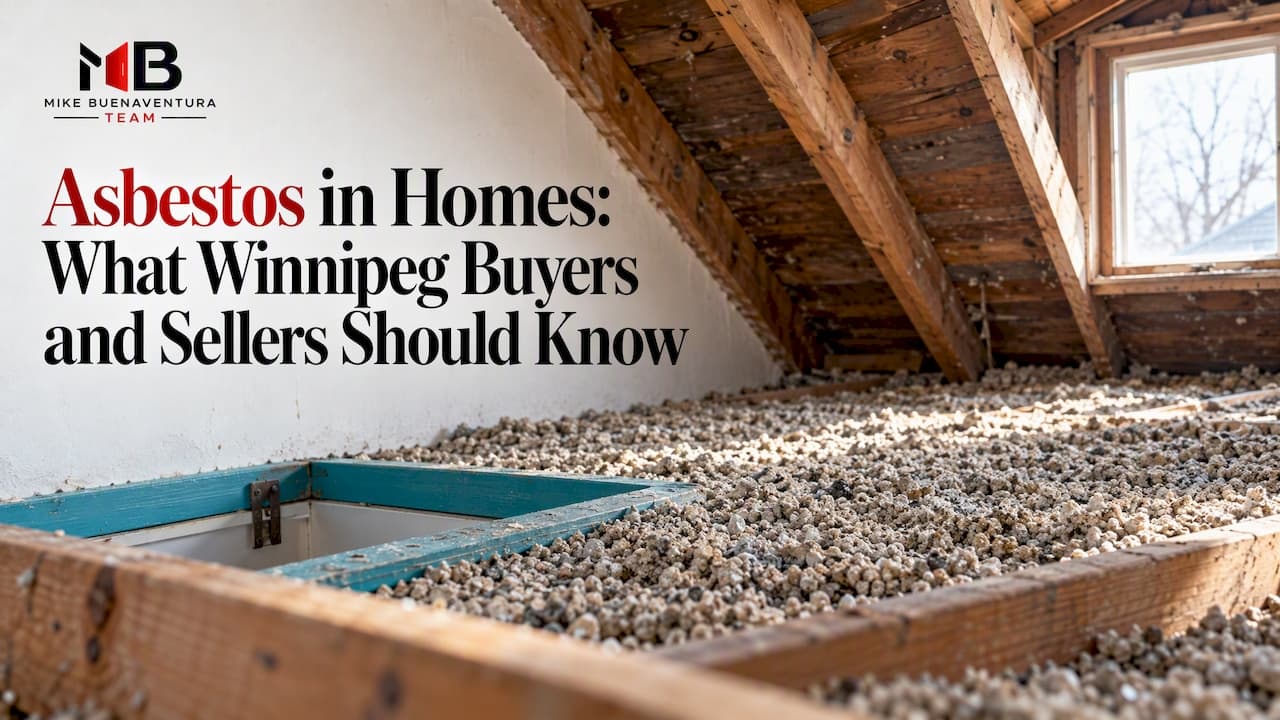
Vermiculite insulation, often found as loose, pebble-like fill in attics, is one to treat carefully. CCOHS advises that vermiculite insulation should not be disturbed or removed by the homeowner. If you see it in an attic, do not poke through it, and do not store boxes in it. Have it assessed by a qualified professional before any work.
Can you tell by looking?
No. CCOHS states plainly that you cannot tell whether a product contains asbestos just by looking at it. The only way to know is to have a sample tested by a laboratory.
That means a home's age, a floor tile pattern or a hunch from a neighbour is not a confirmation either way. Treat suspect materials as suspect, leave them alone and test them before work begins.
When asbestos becomes a health risk
Asbestos poses a health risk when fibres become airborne and are inhaled. Health Canada says this typically happens when materials are damaged, crumbled or disturbed by activities like sanding, drilling, cutting or scraping (Health Canada). Products in good condition may not release fibres, while damaged material can (CCOHS).
Breathing in the fibres can cause lung cancer, asbestosis, mesothelioma and other diseases (Health Canada).
Is a short exposure harmful?
This is the question behind "will 30 minutes of exposure hurt me?" The honest answer is that risk rises with heavier and longer exposure, but the U.S. National Cancer Institute notes that asbestos-related diseases have been found in people with only brief exposures. That is not a reason for alarm about a house you are touring. Walking through a home where materials are intact is not the same as breaking them up. It is a strong reason not to start a DIY demolition on a suspect material. If you believe you were exposed during a project, talk to your doctor and tell them what happened.
What to do if you suspect asbestos
The guidance from Health Canada is consistent and simple: if materials are undamaged and undisturbed, leave them alone. Before renovating, hire a professional to test for asbestos, and if it is found, hire a qualified asbestos removal specialist to remove it safely (Health Canada).
In practice:
- Do not touch it. No scraping, sanding, drilling or sweeping up crumbled debris with a dry broom or a household vacuum.
- Stop any work in progress if you uncover an unfamiliar material, and keep people and pets away from the area.
- Have it sampled. A qualified person takes representative samples and sends them to a lab.
- Decide with the results. Leave it, encapsulate it or have it removed, depending on its condition and your plans.
How testing works
A qualified person should take representative bulk samples of the suspect material, following a recognized method such as NIOSH Method 9002 or an equivalent, according to the federal technical guideline on asbestos exposure management. In that guideline's workplace context, a material testing below 1% asbestos by weight is treated as negative, and 1% or more is positive and calls for an asbestos risk assessment before invasive work.
What is the 3-5-7 rule?
You may see the "3-5-7 rule" mentioned online. It is a sampling guideline for one uniform area of suspect surfacing material, such as a sprayed ceiling: three samples for 1,000 square feet or less, five for more than 1,000 up to 5,000 square feet, and seven for more than 5,000 square feet (Air Quality Testing). It originates in U.S. AHERA regulations and is widely used as a best practice in Canada (Air Quality Testing). It is a guide for professionals, not a rule you apply yourself. For a typical house, the inspector or testing firm decides how many samples are needed.

Manitoba rules to know before renovating
Manitoba has been updating its asbestos rules. Before work to alter, renovate or demolish a building containing asbestos-containing material that may release fibres, the director must be notified five to ten days before the work begins, according to Manitoba Labour and Immigration. The same page says that from June 1, 2027, mandatory certification will be required for workers doing asbestos abatement or inventory development work.
The practical takeaway for a homeowner: use a contractor who works within the current Manitoba requirements, ask what training and certification they hold, and check the provincial page for the current rules before you start. Rules like these evolve, so confirm the details with the province instead of relying on a general article.
Buying a house that may contain asbestos
Many readers arrive here asking whether they can buy a house with asbestos. Yes, people do, and plenty of older homes are lived in safely for decades. What matters is that you go in informed and price the decisions you make.
Questions to ask before you make an offer
- What year was the home built, and what has been renovated? Updated flooring, ceilings and insulation may mean the older materials are gone or covered.
- Has any testing or abatement been done? Ask for lab reports, contractor invoices and permits, and keep copies.
- Is there vermiculite in the attic? Ask your inspector to note it and to say what condition it is in.
- Are there visibly damaged materials? Crumbling pipe wrap, broken old floor tiles or deteriorating ceiling texture matter more than intact ones.
- What do you plan to renovate? Your own plans change the picture. A house you will live in as it is carries a different risk from one where you intend to open walls or redo floors.
Build it into your conditions
A standard home inspection is a visual review, and as the sources above make clear, asbestos cannot be identified visually. If the home is older and you plan renovations, talk to your REALTOR® about a condition in your offer that lets you arrange sampling of suspect materials within your inspection period. A positive result is not automatically a reason to walk away. It gives you information to negotiate on price, ask the seller to address it, or budget for abatement before you begin your project.
We also suggest asking for quotes before you decide, because the cost depends heavily on the material, the amount and where it is. Anyone quoting a figure without seeing the materials is guessing.
If you are earlier in the process, our guides for first-time home buyers in Winnipeg and on hidden closing costs help you plan the full budget around an older home.

Selling a home that may have asbestos
If you own an older Winnipeg home, you do not need to panic, and you do not need to rip anything out to sell. A few habits keep the sale smooth.
- Do not disturb suspect materials before listing. Scraping a ceiling texture or pulling up old tile to "freshen up" the home is exactly the activity the health guidance warns against.
- Gather your records. Past testing, abatement invoices, and renovation permits show buyers you have managed the home responsibly.
- Be honest about what you know. In Manitoba, sellers are generally expected to disclose known material hidden defects that a buyer could not reasonably find on inspection. Talk to your REALTOR® and, for legal questions, a real estate lawyer about what applies to your situation.
- Consider testing first if you know a project or a buyer will raise it. A lab result can replace uncertainty with a fact, which tends to help negotiations.
If you would rather not repair or test anything before listing, selling as-is is an option with its own considerations. Read our guide on how to sell a house as-is in Winnipeg to see how that works.
Our perspective
In our experience guiding Winnipeg buyers and sellers, asbestos is rarely the deal-breaker people fear. It becomes a problem when it is a surprise: found halfway through a renovation, or raised for the first time days before closing.
That is why we focus on clear communication from the first consultation through to closing. For buyers, we help you read an older home's history, decide whether to add an inspection or testing condition, and think through what your renovation plans mean for the property you are considering. For sellers, we help you present the home honestly, and we tailor the marketing and pricing strategy to its actual condition and age.
Every client's goals are different. A first-time buyer who wants to move in and repaint needs different advice from a growing family planning to open up a kitchen. We give advice that fits your goals, so you can make the decision with confidence and without guesswork.
the author
Talk to a Winnipeg team that plans around the details
Whether you are weighing an older home or preparing to sell one, we help you understand what you are dealing with before decisions get expensive. Our Buying a Home service includes property search and negotiation support, and our Home Finder Program helps you find homes that fit your criteria. If you are selling, we begin with a home evaluation so your price and strategy reflect your home as it really is.

When you are ready, reach out about selling your home and we will walk you through the next steps.
Frequently asked questions
Where is asbestos located in a home?
In homes built before the 1990s, it can be in insulation around pipes and tanks, floor and ceiling tiles, plaster, drywall compounds, siding, roofing, caulking, putty and attic insulation. Health Canada lists these older materials. Since you cannot identify it by sight, only a lab test can confirm it.
When did Canada ban asbestos?
The federal prohibition regulations came into force in December 2018. They stop the import, sale and use of asbestos and new products containing it, with limited exclusions. They do not remove asbestos already built into existing buildings, which is why older homes can still contain it.
Is it safe to live in a house with asbestos?
Health Canada's guidance is that materials in good condition that are left undisturbed should be left alone. The concern is fibres released when materials are damaged or disturbed. Before renovating, have the suspect materials tested by a professional and use a qualified specialist for any removal.
Can I buy a house with asbestos?
Yes. Ask about the home's age, renovation history and any testing, and talk to your REALTOR® about adding an inspection or sampling condition when you plan renovations. Test results give you facts to negotiate price or repairs, or to budget for abatement before you start work.
Do I have to disclose asbestos when selling in Manitoba?
Sellers are generally expected to disclose known material hidden defects. If you know about asbestos, or have had it tested or removed, speak with your REALTOR® and a real estate lawyer about how to handle disclosure for your sale.
Sources
- Asbestos and your health, Health Canada
- Asbestos: In the Home, CCOHS
- Prohibition of Asbestos and Products Containing Asbestos Regulations: frequently asked questions, Government of Canada
- Asbestos Exposure and Cancer Risk Fact Sheet, National Cancer Institute
- Technical guideline to asbestos exposure management, Government of Canada
- New asbestos regulations, Manitoba Labour and Immigration
- Asbestos testing in Montreal, Air Quality Testing
- Asbestos testing in Ontario and Quebec, Air Quality Testing